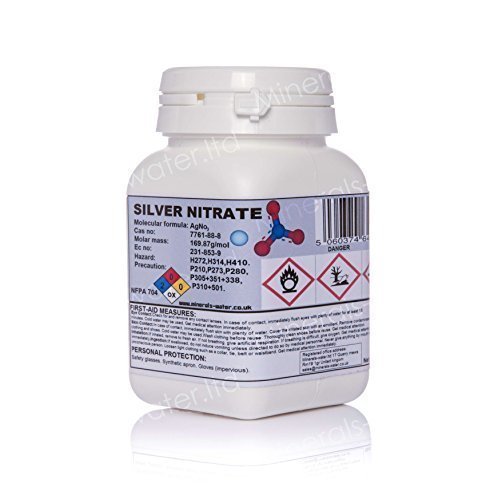
10g Silver nitrate - laboratory reagent is available in Laundry Detergent
Laboratory Reagent. Silver nitrate is used for a variety of things. It is used to make other silver compounds. It is used in photography and has other chemical uses. It is sometimes used in newborns eyes to prevent infection and blindness. It can be used to test for the presence of chloride, bromide, or iodide ions. In biology it is employed as a silver stain to demonstrate proteins and nucleic acids. Silver nitrate is also used in scanning electron microscopy. Halide abstraction The silver cation, Ag+, reacts quickly with halide sources to produce the insoluble silver halide, which is a cream precipitate if Br- is used, a white precipitate if Cl- is used and a yellow precipitate if I- is used. This reaction is commonly used in inorganic chemistry to abstract halides Silver nitrate solution can be used to find out which halogen is present in a suspected halogenoalkane. The most effective way is to do a substitution reaction which turns the halogen into a halide ion, and then to test for that ion with silver nitrate solution Organic synthesis Silver nitrate is used in many ways in organic synthesis, e.g. for deprotection and oxidations. Ag+ binds alkenes reversibly, and silver nitrate has been used to separate mixtures of alkenes by selective absorption Biology In histology, silver nitrate is used for silver staining, for demonstrating reticular fibers, proteins and nucleic acids Antimicrobial uses Water disinfection in hotels and hospitals Postharvest cleaning of oysters and crabs Inhibition of bacterial growth on chicken farms Water recycling aboard space shuttles Home purification of water in Europe and North America Alternative to laundry detergent Application to eyes of newborn babies to prevent infection Coating on catheters to prevent infection In medicine
| Product Group | Kitchen |

Verified Purchase This review is from: 10g Silver nitrate - laboratory reagent

This review is from: 10g Silver nitrate - laboratory reagent
Laboratory Reagent. Silver nitrate is used for a variety of things. It is used to make other silver compounds. It is used in photography and has other chemical uses. It is sometimes used in newborns eyes to prevent infection and blindness. It can be used to test for the presence of chloride, bromide, or iodide ions. In biology it is employed as a silver stain to demonstrate proteins and nucleic acids. Silver nitrate is also used in scanning electron microscopy. Halide abstraction The silver cation, Ag+, reacts quickly with halide sources to produce the insoluble silver halide, which is a cream precipitate if Br- is used, a white precipitate if Cl- is used and a yellow precipitate if I- is used. This reaction is commonly used in inorganic chemistry to abstract halides Silver nitrate solution can be used to find out which halogen is present in a suspected halogenoalkane. The most effective way is to do a substitution reaction which turns the halogen into a halide ion, and then to test for that ion with silver nitrate solution Organic synthesis Silver nitrate is used in many ways in organic synthesis, e.g. for deprotection and oxidations. Ag+ binds alkenes reversibly, and silver nitrate has been used to separate mixtures of alkenes by selective absorption Biology In histology, silver nitrate is used for silver staining, for demonstrating reticular fibers, proteins and nucleic acids Antimicrobial uses Water disinfection in hotels and hospitals Postharvest cleaning of oysters and crabs Inhibition of bacterial growth on chicken farms Water recycling aboard space shuttles Home purification of water in Europe and North America Alternative to laundry detergent Application to eyes of newborn babies to prevent infection Coating on catheters to prevent infection In medicine
Laboratory Reagent. Silver nitrate is used for a variety of things. It is used to make other silver compounds. It is used in photography and has other chemical uses. It is sometimes used in newborns eyes to prevent infection and blindness. It can be used to test for the presence of chloride, bromide, or iodide ions. In biology it is employed as a silver stain to demonstrate proteins and nucleic acids. Silver nitrate is also used in scanning electron microscopy. Halide abstraction The silver cation, Ag+, reacts quickly with halide sources to produce the insoluble silver halide, which is a cream precipitate if Br- is used, a white precipitate if Cl- is used and a yellow precipitate if I- is used. This reaction is commonly used in inorganic chemistry to abstract halides Silver nitrate solution can be used to find out which halogen is present in a suspected halogenoalkane. The most effective way is to do a substitution reaction which turns the halogen into a halide ion, and then to test for that ion with silver nitrate solution Organic synthesis Silver nitrate is used in many ways in organic synthesis, e.g. for deprotection and oxidations. Ag+ binds alkenes reversibly, and silver nitrate has been used to separate mixtures of alkenes by selective absorption Biology In histology, silver nitrate is used for silver staining, for demonstrating reticular fibers, proteins and nucleic acids Antimicrobial uses Water disinfection in hotels and hospitals Postharvest cleaning of oysters and crabs Inhibition of bacterial growth on chicken farms Water recycling aboard space shuttles Home purification of water in Europe and North America Alternative to laundry detergent Application to eyes of newborn babies to prevent infection Coating on catheters to prevent infection In medicine
Laboratory Reagent. Silver nitrate is used for a variety of things. It is used to make other silver compounds. It is used in photography and has other chemical uses. It is sometimes used in newborns eyes to prevent infection and blindness. It can be used to test for the presence of chloride, bromide, or iodide ions. In biology it is employed as a silver stain to demonstrate proteins and nucleic acids. Silver nitrate is also used in scanning electron microscopy. Halide abstraction The silver cation, Ag+, reacts quickly with halide sources to produce the insoluble silver halide, which is a cream precipitate if Br- is used, a white precipitate if Cl- is used and a yellow precipitate if I- is used. This reaction is commonly used in inorganic chemistry to abstract halides Silver nitrate solution can be used to find out which halogen is present in a suspected halogenoalkane. The most effective way is to do a substitution reaction which turns the halogen into a halide ion, and then to test for that ion with silver nitrate solution Organic synthesis Silver nitrate is used in many ways in organic synthesis, e.g. for deprotection and oxidations. Ag+ binds alkenes reversibly, and silver nitrate has been used to separate mixtures of alkenes by selective absorption Biology In histology, silver nitrate is used for silver staining, for demonstrating reticular fibers, proteins and nucleic acids Antimicrobial uses Water disinfection in hotels and hospitals Postharvest cleaning of oysters and crabs Inhibition of bacterial growth on chicken farms Water recycling aboard space shuttles Home purification of water in Europe and North America Alternative to laundry detergent Application to eyes of newborn babies to prevent infection Coating on catheters to prevent infection In medicine
